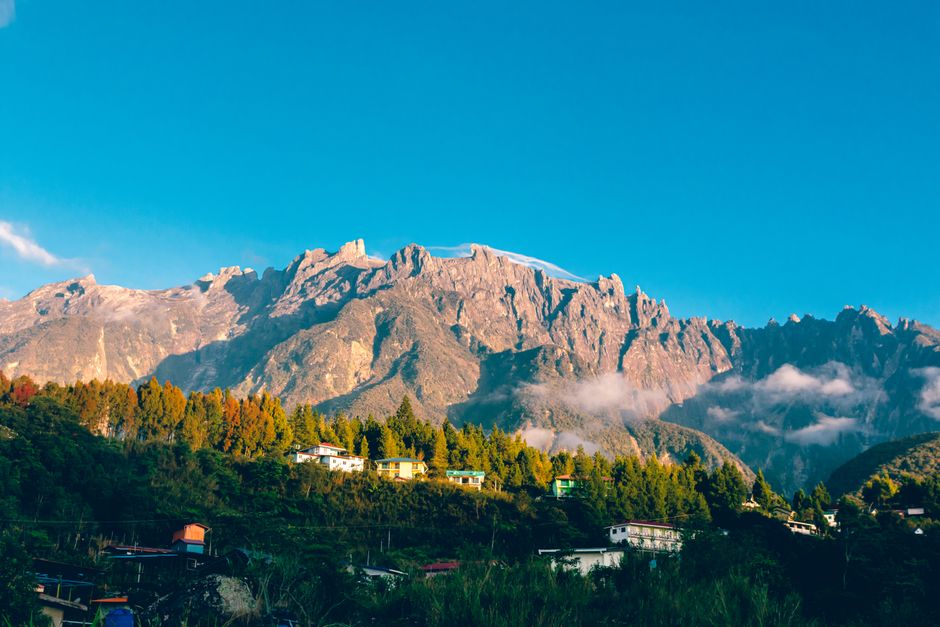
Mount Kinabalu is the highest peak in Southeast Asia at 4,095 metres — and one of the most accessible major summits in the world. No ropes, no technical climbing skills, no crampons. Just a two-day guided hike up well-maintained trails, a pre-dawn push to the summit, and a view over Borneo at sunrise that rewards every painful step. This guide covers how to book, what it costs, and exactly what to expect.
🎟 [Travelpayouts 12Go widget: Transport from Kota Kinabalu to Kinabalu Park]
⚠️ Permits are strictly limited to 163 climbers per day and sell out months in advance — especially for December to February and July to August. Book at sabapakeco.com as soon as your dates are confirmed. Do not book flights before confirming your permit.
The Basics: What You Need to Know
- Summit: Low\’s Peak, 4,095.2 metres (13,435 feet)
- Location: Sabah, East Malaysia (Borneo island)
- Trail: Ranau Trail via Timpohon Gate — the standard route. Mesilau Trail closed indefinitely.
- Duration: 2 days / 1 night minimum. 3 days recommended for acclimatisation.
- Difficulty: Strenuous but technically straightforward. No climbing experience needed — good physical fitness essential.
- Mandatory guide: A licensed mountain guide is required by park regulation. Max 5 climbers per guide.
- Daily permit limit: 163 permits per day total (both trails combined)
How Much Does It Cost?
The total cost to climb Mount Kinabalu starts from MYR 1,150 (~$260 USD) per person for budget options, up to MYR 3,240 (~$730 USD) for premium packages including Via Ferrata. The mandatory package includes:
- Climbing permit (Sabah Parks fee)
- Mountain guide fee
- Park entrance fee
- Overnight accommodation at Laban Rata or Pendant Hut (~3,272m)
- Meals (dinner and breakfast at the mountain hut)
- Climbing insurance
Transfers from Kota Kinabalu city to Kinabalu Park (~88 km, ~2 hours) are usually available as an add-on from ~$15–25 USD per person.
ℹ️ The only official booking platforms are sabapakeco.com (Sabah Parks) and authorised agents like Amazing Borneo, Borneo Adventure, and mountkinabalu.com. Avoid third-party resellers charging inflated prices. Do not trust scam sites — Sabah Parks has explicitly warned against bogus booking websites.
Getting to Kinabalu Park from Kota Kinabalu
Kinabalu Park headquarters is 88 km east of Kota Kinabalu city — approximately 2 hours by road. Options:
- Express bus from Inanam bus terminal (KK): Departs 07:00 and 08:00 toward Ranau, stops at Kinabalu Park — ~MYR 15–20 (~$3–4 USD), ~2 hours. This is the cheapest option but you need to be at the terminal early.
- Minibus from Padang Merdeka (Wawasan Plaza area): Shared minibuses to Ranau pass Kinabalu Park — depart when full from early morning, ~MYR 20–25 (~$5–6 USD). Slightly less reliable schedule.
- Chartered taxi: ~MYR 150–200 (~$33–45 USD) for the whole vehicle. Best for groups of 3–4. Ask your KK hotel to arrange.
- Package transfer: Most climb packages include a return transfer from KK city — simplest option, usually meeting at Sabah Tourism Board building at 06:15.
🎟️ Search Kota Kinabalu → Kinabalu Park tickets on 12Go →
The Climb: What to Expect
Day 1: Timpohon Gate to Laban Rata (~6 km, ~1,400m elevation gain)
Registration opens at Park HQ at 07:00. You\’re transferred to Timpohon Gate (1,866m) for the start. The trail climbs steadily through montane forest — well-maintained with rope handrails on steeper sections, rest shelters every kilometre or so. Most climbers take 4–6 hours to reach Laban Rata (3,272m). The forest transitions from tall trees to dwarf vegetation, then alpine scrub as you ascend. Views open up from around 3,000m.
Laban Rata is a mountain hut complex with dormitory and private rooms, a heated canteen, hot showers, and a medical post. Dinner is served from 17:00 — eat well, rest early. Summit push begins at 02:00.
Day 2: Laban Rata to Low\’s Peak Summit and Descent
Wake up at 02:00 for breakfast. Depart the hut by 02:30–03:00 with headlamps for the summit push (~2.7 km, ~820m gain from Laban Rata). The trail above the hut crosses open granite slabs — fixed ropes guide the way in the dark. It\’s cold (often 5–10°C at the summit), potentially windy, and physically demanding. Most climbers reach Low\’s Peak by 05:30–06:00 — in time for sunrise over Borneo.
Descent takes 3–5 hours from the summit back to Timpohon Gate. Knees take significant impact on the way down — trekking poles are strongly recommended. Total descent elevation: ~2,229m.
Via Ferrata: The World\’s Highest
Mount Kinabalu hosts the world\’s highest via ferrata — a series of iron rungs, cables, and walkways bolted into the granite above Laban Rata. Two routes: Low\’s Peak Circuit (3.5–4 hours, more challenging) and Walk the Torq (1.5–2 hours, better for beginners). Both traverse the exposed granite face with spectacular exposure over the Borneo lowlands. Costs MYR 200–400 extra depending on route. Book as part of your climb package — cannot be added on arrival.
What to Bring
- Warm layers (essential): Temperature at summit can drop to 2–5°C, with wind chill making it feel colder. Thermal base layer, fleece, and waterproof shell minimum.
- Trekking poles: Strongly recommended for the descent — saves knees significantly.
- Headlamp: Mandatory for the pre-dawn summit push. Bring spare batteries.
- Waterproof boots or trail shoes: The trail is paved in sections but can be wet. Ankle support helpful.
- Snacks: Chocolate, energy gels, nuts for the summit push — the canteen at Laban Rata serves dinner and breakfast but nothing is available on the summit trail.
- Water: 2+ litres. Refill at Laban Rata before the summit push.
Best Time to Climb
- March–September: Dry season in Sabah — best summit visibility, lower chance of cloud. March–April and July–August are peak months.
- October–February: Northeast monsoon brings more rain and cloud — summit views less reliable, but the mountain is quieter and cheaper. Still climbable.
- Avoid: The mountain closes approximately 15 times per year due to severe weather. Summit closure rates are higher October–January.
Where to Stay in Kota Kinabalu
Most climbers fly into Kota Kinabalu (BKI) and stay 1–2 nights before and after the climb. KK is a pleasant coastal city with good seafood, a waterfront promenade, and easy access to the Tunku Abdul Rahman Marine Park islands.
🏨 [Travelpayouts Hotellook/Agoda widget: Hotels in Kota Kinabalu]
🏨 [Travelpayouts Hotellook/Agoda widget: Hotels near Kinabalu Park (Kundasang)]
Frequently Asked Questions
How fit do I need to be?
Significantly fitter than average. The ascent involves 2,229m of elevation gain over 8.7 km — equivalent to climbing a very steep staircase continuously for 4–6 hours. Regular cardio exercise (running, hiking, cycling) for 6–8 weeks before the climb is strongly recommended. Age is less important than cardiovascular fitness.
Can children climb?
Minimum age is 10 years old. Children under 16 are considered “Child” and must be accompanied by a separate mountain guide (additional cost). Children must demonstrate adequate fitness — the climb is genuinely demanding for adults, let alone young children.
What if the summit is closed due to weather?
If the summit is declared unsafe by rangers, all climbers stop at Sayat-Sayat checkpoint (~3,668m) and must turn back. No refund is given for a weather-related summit closure — this is stated clearly in booking terms. The chance of summit closure is approximately 15–20 times per year.
Related Guides
- Kota Kinabalu and Borneo: Complete Guide
- Kuala Lumpur to Kota Kinabalu: Flights Guide
- Malaysia to Thailand: Complete Guide
This post contains affiliate links. When you book through them, we may earn a small commission at no extra cost to you.